The useful life of professional knowledge is becoming shorter, but most working adults cannot pause their careers whenever their industries change. Employers face the same problem from another direction: they need new capabilities faster than traditional education systems often produce them. Artificial intelligence, digitalization, and the green transition have made this tension harder to ignore. Therese Bohlin and IHM Business School are operating where education, employment, and business performance increasingly overlap.
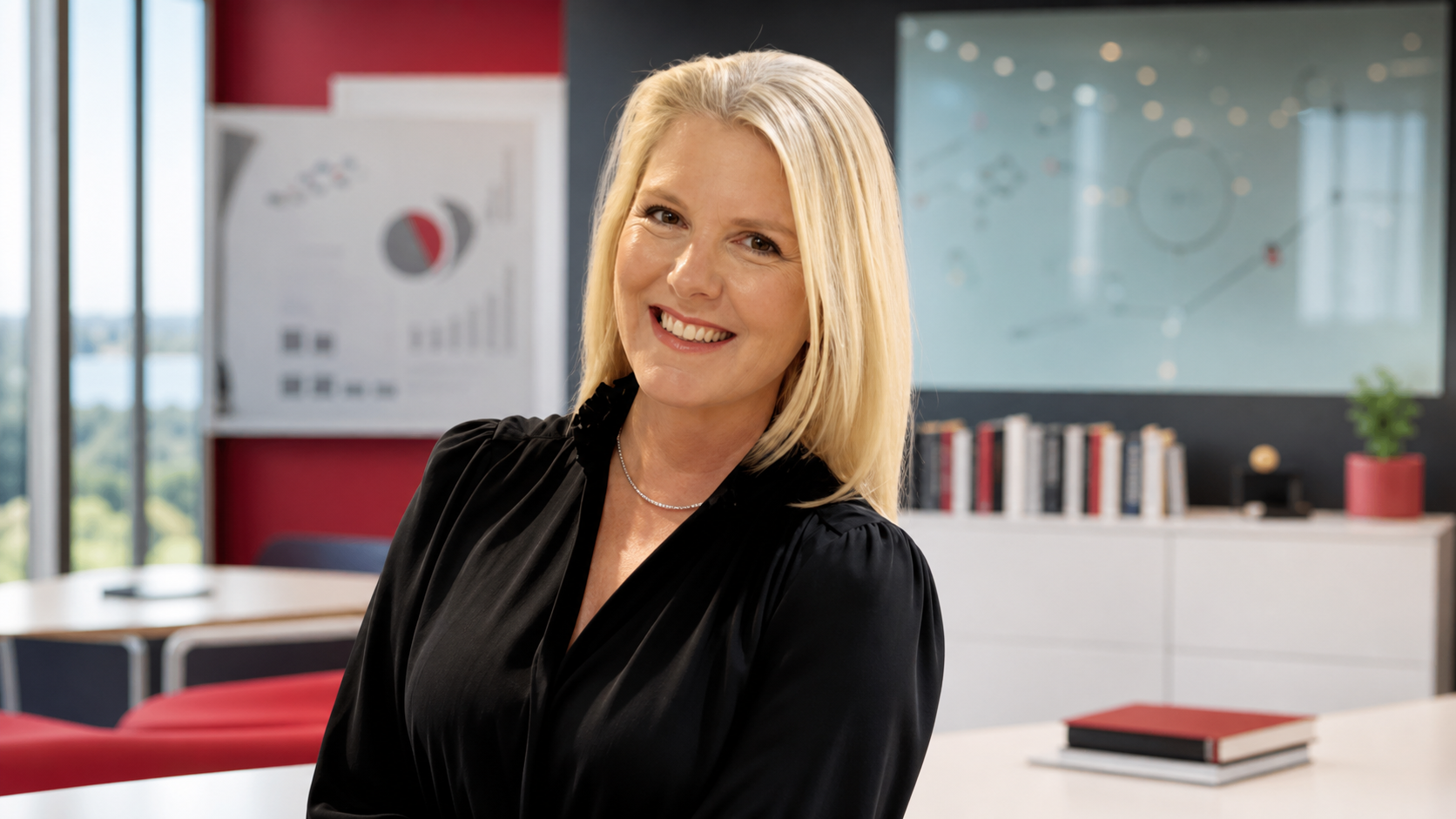
Bohlin became CEO of IHM Business School in February 2025, taking responsibility for a Swedish institution that has provided business education since the 1960s. The school offers vocational programs, executive-level qualifications, short courses, and customized education for organizations. Its students frequently combine learning with active professional responsibilities, making immediate workplace relevance essential. Bohlin’s challenge is to preserve IHM’s established credibility while preparing its programs for skills that employers may only be beginning to understand.
The Problem IHM Business School Was Really Solving
Traditional education usually prepares people before they enter a profession, while modern careers require repeated learning after employment begins. Workers may discover that the tools, commercial expectations, or leadership demands surrounding their roles have changed significantly within a few years. Returning to a full-time university program is unrealistic for many professionals with jobs, families, and financial commitments. IHM Business School addresses this gap by designing education that can operate alongside working life.
Employers experience the gap through recruitment difficulties and internal capability shortages. Hiring externally can solve an immediate need, but it does not automatically strengthen the existing organization or prepare employees for future responsibilities. Companies increasingly require practical development in leadership, marketing, sales, business finance, artificial intelligence, and organizational change. IHM’s model connects those needs with programs shaped by active participation from the business community.
The deeper problem is not access to information, because professional knowledge has never been easier to find. The difficulty is determining which knowledge matters, practicing it in realistic situations, and applying it inside an organization. Videos and online resources can explain a concept without developing the judgment required to use it well. IHM’s role is therefore less about distributing information and more about turning learning into professional capability.
Why Therese Bohlin Saw the Industry Differently
Therese Bohlin arrived at IHM with experience in strategic leadership, organizational development, communications, and advisory work. She previously served as CEO of Prime Weber Shandwick, COO of Prime and United Minds, and strategic director at Storåkers McCann. These roles placed her inside knowledge-based businesses where success depended on understanding change before clients could fully describe it. That background gives her a practical view of how organizations absorb new ideas and why strategies often fail during implementation.
Bohlin’s perspective treats education as part of workforce infrastructure rather than a separate social service. Businesses cannot respond effectively to technological and economic shifts if employees lack opportunities to update their skills. At the same time, training delivers limited value when it remains disconnected from decisions, routines, and measurable responsibilities. Her emphasis on connecting strategic goals with practical implementation fits closely with IHM’s workplace-oriented approach.
The Therese Bohlin IHM Business School agenda also acknowledges that professional learning contains emotional and financial barriers. Adults may worry that they are too old to retrain, lack sufficient time, or cannot justify the cost during uncertain economic conditions. IHM’s 2025 IHMpact Report, based on more than 2,000 interviews, examined these obstacles alongside public attitudes toward lifelong learning. The findings indicated strong interest in continued development despite concerns surrounding AI, finances, age, and time.
What Made Therese Bohlin Different From Competitors
Business schools compete not only with one another but also with universities, internal corporate academies, online platforms, consultants, and freely available digital content. Therese Bohlin has inherited an institution whose advantage depends on maintaining close connections with working professionals and employers. IHM’s programs are delivered by teaching consultants who remain active in business, allowing practical developments to influence the classroom. This structure helps the school respond more quickly than institutions built around slower academic cycles.
IHM also serves several distinct learning needs within one organization. Its vocational programs help students prepare for specific professional roles, while executive programs support experienced managers and specialists seeking broader commercial judgment. Short courses allow professionals to update targeted skills, and customized programs help employers address organizational priorities. This range enables IHM to support people at different stages without assuming that every learner needs the same educational journey.
Bohlin’s leadership style appears particularly suited to managing the relationships behind this model. Her previous work involved advising organizations, interpreting complex changes, and connecting strategy with communication. At IHM, those abilities can help strengthen cooperation with businesses and the public sector while keeping educational products relevant. The risk is that responding too closely to immediate employer demand could weaken the deeper thinking that gives education lasting value.
The Decision That Changed IHM Business School
One important decision under Bohlin’s leadership has been to strengthen education that develops capability through real workplace practice. IHM Business School entered a strategic collaboration with Nya Ledarskapet to offer an extended leadership-development program based on individual training within participants’ existing jobs. Rather than concentrating learning into a short classroom experience, the program integrates practice, reflection, and coaching over several months. The structure reflects a belief that leadership improves through repeated behavior rather than theory alone.
The decision matters because leadership education is crowded with brief courses that produce enthusiasm without lasting behavioral change. Participants may understand a new framework during training but return to workplaces where established pressures quickly restore old habits. Long-term individual training creates more opportunities to test decisions, receive feedback, and adjust behavior. It also makes the employer’s working environment part of the educational process.
This approach carries commercial and operational risks. Extended programs require sustained commitment from participants, employers, trainers, and the school itself. The value may become visible gradually, making it harder to sell than a shorter course with an immediate certificate. Yet the decision reveals Bohlin’s preference for education that produces observable professional change instead of simply delivering content.
Turning Mission Into Operations
A promise to support lifelong learning becomes credible only when people can access education without abandoning their existing responsibilities. IHM Business School operates through physical locations, regional study opportunities, distance learning, and programs designed to run alongside employment. In spring 2025, more than 2,000 people studied in its vocational qualification programs, while hundreds more participated in shorter vocational courses. Delivering education at that scale requires consistent quality across formats, locations, instructors, and subject areas.
Program design must also keep pace with changing business requirements. IHM covers established disciplines such as sales, marketing, finance, management, and business development while expanding learning related to AI, data, digital commerce, and sustainability. Adding fashionable subjects is easy; creating programs that professionals can use responsibly is more difficult. The school must distinguish between temporary excitement and capabilities that will remain valuable after particular technologies or trends change.
Bohlin must also manage the relationship between educational credibility and commercial responsiveness. Employers want programs tailored to their immediate challenges, but students need knowledge that remains useful beyond one company or assignment. IHM’s qualifications and quality frameworks provide structure, while its business connections help maintain practical relevance. Preserving both sides requires continuous evaluation rather than relying on the school’s history or reputation.
The Difficult Reality of Scaling
Demand for professional development does not automatically translate into participation. Workers may recognize the need to learn while lacking time, employer support, or confidence that education will improve their careers. Organizations may describe talent development as a priority but reduce training budgets when financial conditions tighten. IHM Business School must therefore demonstrate value to both learners and employers before, during, and after each program.
Artificial intelligence creates another pressure point. It is generating urgent demand for new skills while also raising questions about which tasks, roles, and management practices will remain relevant. Schools risk moving too slowly and teaching outdated practices, or moving too quickly and building programs around tools that soon lose importance. Bohlin’s team must update content without confusing novelty with durable business capability.
Scale also creates internal strain. A broad portfolio serving vocational students, executives, companies, and public organizations requires different teaching formats, sales processes, and measures of success. Expanding digital access can increase reach, but it may weaken the discussion and professional networking that make business education valuable. Bohlin’s challenge is to extend IHM’s relevance without allowing growth to reduce the quality of the learning experience.
What Therese Bohlin’s Story Actually Reveals
The work of Therese Bohlin reflects a larger change in how responsibility for education is distributed. Schools can no longer assume learning ends with graduation, employers cannot depend entirely on recruiting new skills, and individuals cannot predict one stable career path. Each party must participate in continuous development, even when time and resources are limited. Institutions such as IHM increasingly act as connectors between those responsibilities.
The Therese Bohlin IHM Business School agenda reveals that the future of business education will depend less on possessing information and more on helping people use it under real pressure. Relevance must be continually earned through practical outcomes, credible standards, and honest engagement with uncertainty. Bohlin’s task is not simply to prepare students for the next role. It is to help build a system where learning remains possible throughout working life.