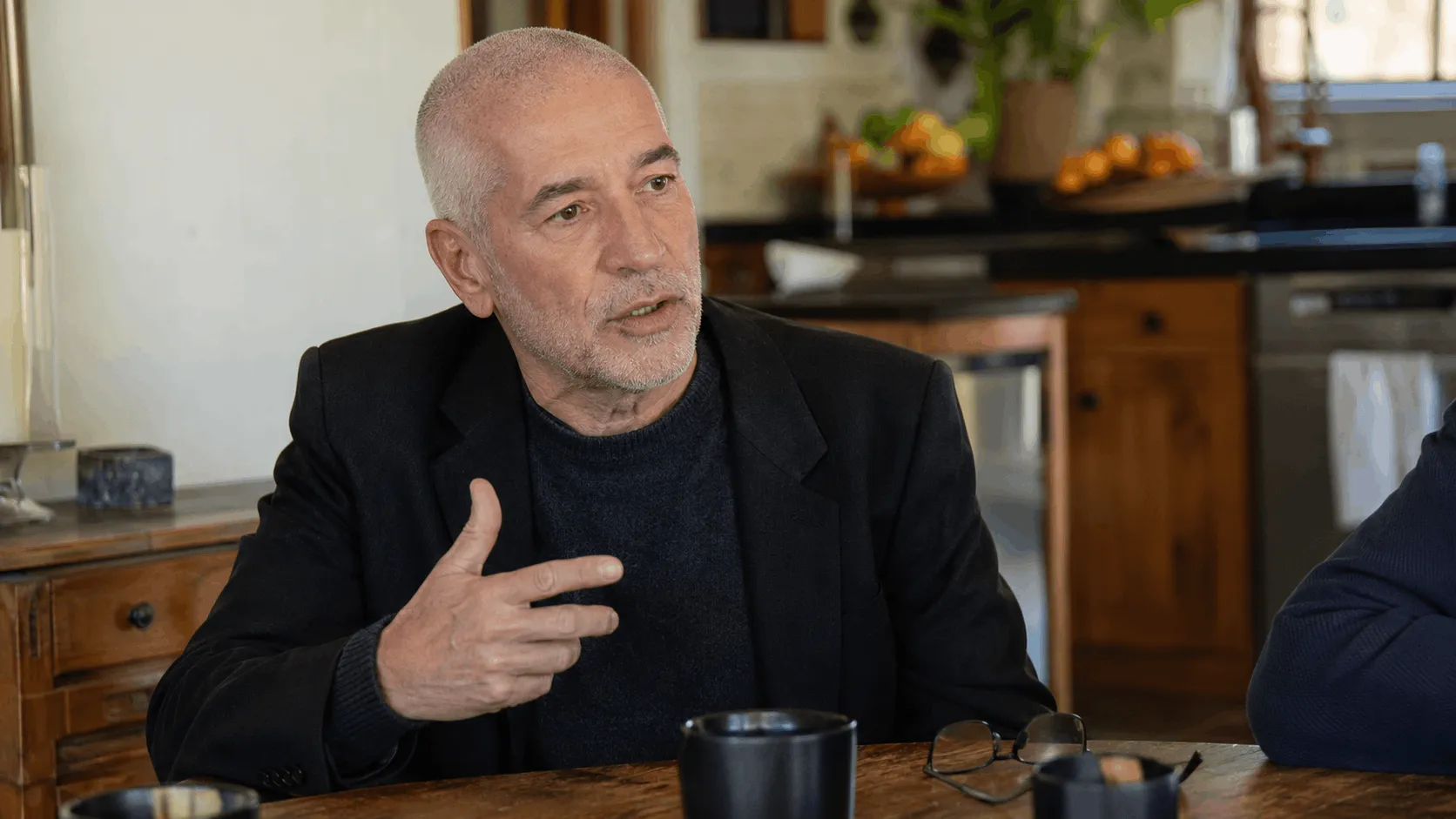
Stanley Tucci’s net worth is $25 million, according to Celebrity Net Worth. The figure reflects four decades of character acting, a run of directing and writing credits, and a second career in food television that reintroduced him to a much younger audience.
Quick Facts
| Detail | Information |
| Full Name | Stanley Oliver Tucci Jr. |
| Net Worth | $25 million |
| Profession | Actor, director, writer, producer |
| Born | November 11, 1960, Peekskill, New York |
| Age | 65 |
| Primary Income Source | Film and television acting, directing, CNN travel series, cookbooks |
Early Life and Background
Tucci grew up in Katonah, New York, the oldest of three children. His father taught art at a public high school, and his mother worked as a secretary and later a writer. Both sides of the family trace back to Calabria, in southern Italy, and the household ran on home cooking long before food television made that part of his public identity.
He studied at the State University of New York’s Conservatory of Theatre Arts in Purchase, graduating in 1982. That same year he made his Broadway debut in “The Queen and the Rebels,” a part he landed after a family connection to actress Colleen Dewhurst, who arranged small roles for Tucci and his high-school friend Campbell Scott. Three years later he appeared in his first film, John Huston’s “Prizzi’s Honor.”
Tucci spent years building range in theater before film work paid consistently, a slower path to income than a breakout debut role. It explains why his early filmography, dozens of small parts through the late 1980s, reads more like an apprenticeship than a launch.
Career and Income Breakdown
Building a Character-Actor Résumé
Through the late 1980s and 1990s, Tucci worked steadily in supporting roles, including “Billy Bathgate,” “The Pelican Brief,” and “Kiss of Death.” None of these made him a household name on their own, but they built the reputation directors rely on when casting a smaller part that still needs to land.
That changed in 1996 with “Big Night,” a film about two Italian immigrant brothers running a struggling restaurant. Tucci co-wrote, co-directed, and starred in it. The film established him as someone who could work behind the camera as well as in front of it, and it set the template for the food-centered projects he’d return to decades later.
“Big Night” didn’t turn Tucci into a box-office draw, but it changed how studios viewed him. A character actor who can also write and direct gets offered projects where he can negotiate a producing credit or a share of the profits instead of a flat fee, and that shift in leverage broadened his income base earlier than it does for most supporting players.
From Supporting Roles to Recognizable Name
The 2000s and 2010s brought steadier, higher-profile work. Tucci appeared in “Road to Perdition,” “The Terminal,” “The Devil Wears Prada,” “Julie & Julia,” and “Captain America: The First Avenger.” His performance as a child killer in “The Lovely Bones” (2009) earned him an Academy Award nomination for Best Supporting Actor, along with BAFTA and Golden Globe nods.
Playing Caesar Flickerman in “The Hunger Games” franchise put him in front of a global audience that had no idea he’d already won two Emmy Awards, for “Winchell” and “Monk,” plus a Golden Globe for HBO’s “Conspiracy.” That combination, prestige credibility plus blockbuster visibility, is a big part of why his acting fee climbed over time even without a single career-defining lead role.
For the “Lovely Bones” role, Tucci reportedly worked with a retired FBI profiler to build the character, according to TV Guide. That kind of preparation is part of why directors who need a smaller role handled with precision keep returning to him, which shows up in the volume of prestige work he booked afterward, including “Spotlight” and “Feud: Bette and Joan,” the latter earning him another Emmy.
The Food Media Pivot
Tucci’s clearest income diversification came from food television. “Stanley Tucci: Searching for Italy” premiered on CNN in 2021 and became a genuine ratings success, leading to a second series, “Tucci in Italy.” He has also written multiple cookbooks, including “The Tucci Cookbook” and “The Tucci Table,” and a memoir, “Taste: My Life Through Food,” which became a bestseller.
According to reporting cited by Social Life Magazine, Tucci’s CNN deal and book advances have added a revenue stream that doesn’t depend on landing acting roles at all. That matters for a character actor whose film salary was never going to match a leading man’s, because it gives him income that scales with his personal following instead of a single production’s budget.
The timing also matters. “Searching for Italy” arrived in 2021, close to sixty for Tucci, a point in most actors’ careers when film offers slow down rather than speed up. Food television gave him a new audience that had never seen “Big Night” or “The Devil Wears Prada,” and that audience buys cookbooks in a way that doesn’t overlap much with his older fan base. Building a second, younger audience late in a career is a meaningful reason his net worth kept climbing through his sixties instead of leveling off.
Directing, Writing, and Producing Credits
Beyond “Big Night,” Tucci directed “The Impostors,” “Joe Gould’s Secret,” “Blind Date,” and “Final Portrait.” He wrote or co-wrote several of those screenplays. Directing and producing fees, plus any backend points on a film’s profits, sit on top of his acting income and are part of why his net worth has grown steadily rather than in sudden jumps tied to one big paycheck.
None of these directing projects were major commercial hits. Their value to Tucci is less about box office and more about ownership: an actor paid a flat fee for a supporting role earns once, while a writer-director-producer on a smaller, independently financed film can hold a stake in it for years through streaming and home video.
Income Sources
Tucci’s $25 million comes from several channels rather than one dominant source. Film and television acting fees remain the largest historical contributor, built up over roughly 80 credits since 1985. Directing and writing fees from his own projects, starting with “Big Night,” add a second layer. His CNN travel series and any related licensing income form a third stream that has grown significantly since 2021. Book advances and royalties from his cookbooks and memoir round out the picture, along with occasional commercial and brand work.

Award recognition doesn’t pay directly, but it affects every one of those channels. Two Emmy wins, two Golden Globe wins, and an Academy Award nomination give a supporting actor negotiating leverage that a similarly experienced but less decorated peer wouldn’t have. That leverage shows up in book advances and speaking engagements as much as it does in acting fees, since publishers and networks price a project partly on the recognizability of the name attached to it.
Notable Assets
Public records cited by Celebrity Net Worth show Tucci sold a 5,405-square-foot home on six acres in South Salem, New York, in 2013, around the time he relocated. He and his wife, Felicity Blunt, now live in London with their children. The Birmingham Journal has reported that Tucci holds property in Italy, London, and New York, though it describes those details as unconfirmed rather than verified. This article treats that claim the same way, as a reported detail rather than a settled fact, since no public filing was cited to support it.
Personal Life and Career Longevity
Tucci’s first wife, Kate Tucci, died of cancer in 2009. He married literary agent Felicity Blunt, sister of actress Emily Blunt, in 2012. Together they have five children between his first marriage and their own. [internal link opportunity: related profile on Emily Blunt]
Tucci was also treated for cancer himself, a diagnosis he kept private for a period before discussing it publicly in his memoir. That stretch coincided with the period leading into “Searching for Italy,” and he has since described the food series as part of what pulled him back into public work. It’s a detail most net-worth pages skip, but it’s directly relevant to why his highest-earning phase came later in his career rather than at its commercial peak in the early 2010s.
His sister, Christine Tucci, is also a working actress, and the two grew up in the same Katonah household that shaped his food-first identity.
How Stanley Tucci’s Net Worth Compares
Among veteran character actors with a similar résumé, Tucci’s $25 million sits in a familiar range. J.K. Simmons, another prolific supporting actor with an Academy Award and decades of steady work, has an estimated net worth of $20 million, according to Celebrity Net Worth. Both built their wealth through volume and reliability rather than a single blockbuster payday, which is the more common path for character actors compared with leading-role stars.
The gap between the two also points to why Tucci’s food-media pivot matters so much for his specific total. Simmons has voice work and commercial deals as a secondary income stream, but nothing on the scale of a CNN series and multiple bestselling books. That extra channel is the clearest reason Tucci’s figure sits a few million above a peer with a comparably long, award-decorated résumé